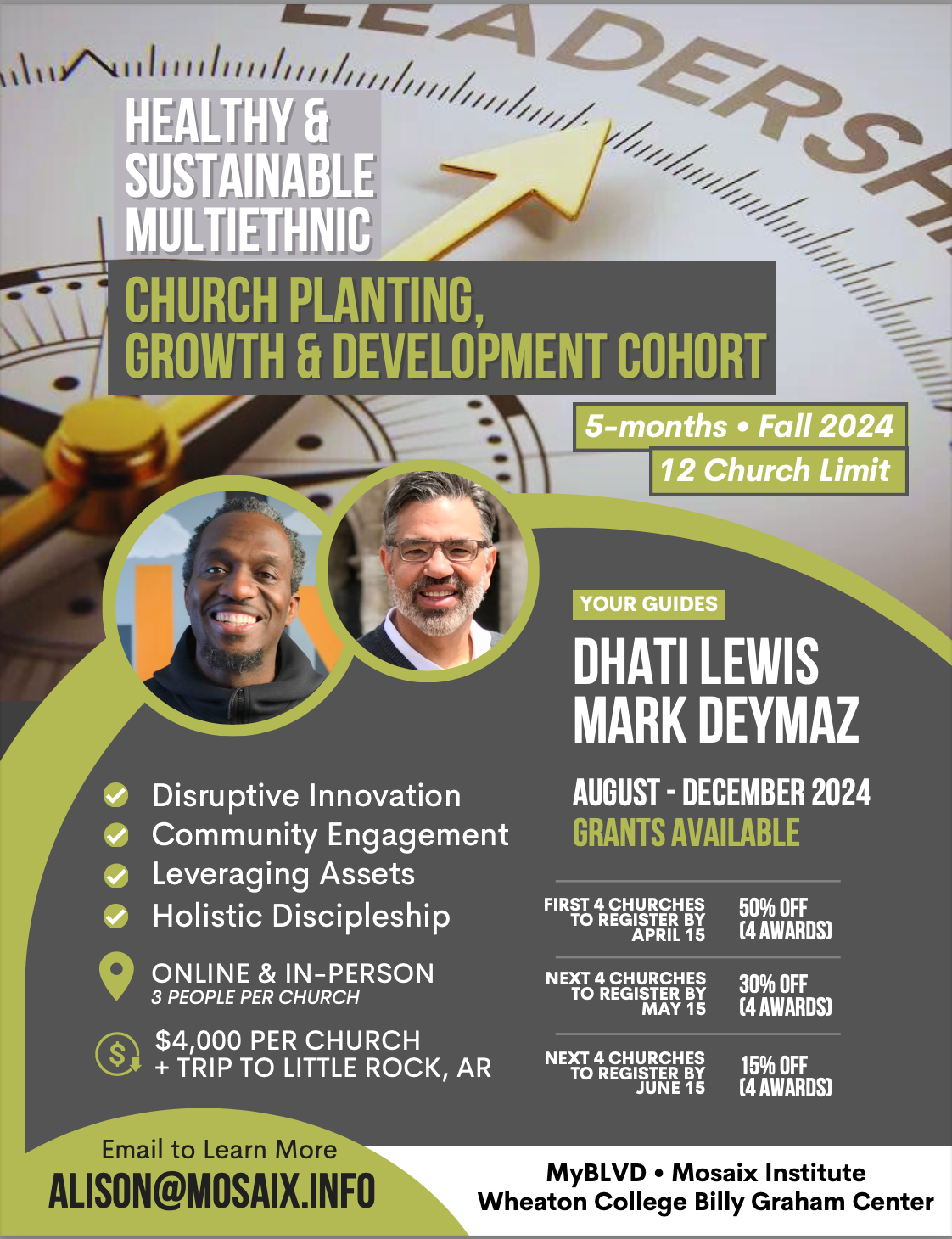
And don't miss the Multi-ethnic Church Conference coming to San Diego, November 2-3! Early bird pricing is available through April 30, 2010.
Posted at 01:34 PM in Books, Video Podcasts | Permalink | Comments (1) | TrackBack (0)
I. Four I wills: (1-3) I will …
1.
Give You thanks, O Lord (appreciation)
2.
Sing Your praises before the (above all
other) gods (witness)
3.
Bow before Your holy temple (submission)
4.
Praise Your name (worship for who He is,
what He’s done)
a.
for Your unfailing love
b.
for Your faithfulness
c.
because Your promises are backed by the
honor of Your name
d.
because as soon as I pray, you encourage me by
giving me strength
Every king on earth will thank You, for all of them will hear Your words via my witness
1.
They will sing of Your ways (after I tell them).
2.
For the glory of the Lord (the way He shows up and out) is very great!
David expects God to move in/through His witness to the kings
a.
Though the Lord is great, He cares for the humble (so be humble)
b. But He keeps His distance (is opposed) to the proud (so don’t be proud)
III. Though
I (a king) am surrounded by troubles: (7-8)
1. You will protect me
From the anger of my enemies
2. You will save me
Through the power of Your right hand
3. You will work out Your plans for me
For my life
4. You will be faithful to me
For your love endures forever
5. You will not abandon me
For You made me, You are my Creator
He will do the same for us if we live humbly before Him in:
1.
Appreciation
2.
Witness
3.
Submission, and
4.
Worship
See also Micah 6:8
Posted at 09:35 AM | Permalink | Comments (0) | TrackBack (0)
In advance of the Verge Conference later this week and a new blog (re) post from Ed Stetzer discussing the "missional conversation," here's an excerpt from my new book, Ethnic Blends: Mixing Diversity Into Your Local Church. The book is being published by Zondervan as part of Leadership Network's Innovation Series, and will be released in April 2010.
Here's the excerpt:
Have you ever wondered why it was the church at Antioch and not the church at Jerusalem that sent the first missionaries into the world? God said go (Matthew 28:19, 20; Acts 1:8), but the saints in Jerusalem said NO! In fact, it wasn’t until the church was persecuted that individuals were forced to carry the message of Christ to other lands and people (Acts 11:18, 19).
In contrast, the church at Antioch was proactive and eager to send Paul and Barnabus forth to distant lands. But why?
c. Mark DeYmaz. Ethnic Blends, pp. 116, 118-119
In the end, then, the missional conversation in a multi-ethnic church is not programatic in natuire; rather, it is who we are.
Posted at 11:00 AM | Permalink | Comments (2) | TrackBack (0)
The following was taken from a message I shared at Mosaic Church of Central Arkansas in Little Rock on October 18, 2009. To hear this important message in its entirety, click here for the mp3 version.
This morning, I want to share a deep concern for the future health and well-being of Mosaic. More than that, it is a concern for you and the future of children growing up in an increasingly post-Christian North America. In addition, it is a concern for the future of the local church,the expression (as defined in the Bible) of the body and bride of Christ. It is a concern that needs to be addressed with sustained, intentional effort - by a decision to align ourselves and our families, immediately, with the ancient faith in Christ and Biblical practice of Christianity.
1. Although 45% of respondents considered themselves religious, 70% said they participated in organized religion sporadically or not at all.
2. 50% said they rarely or never attend worship services.
3. Is it any wonder, then, that only 12% of respondents said that their own religion was the only true faith.
4. And another 24% of respondents put themselves in a whole new category: “spiritual but not religious.”
Religion is “A commitment or devotion to religious faith or observance.” In other words, to say that we are religious is to say that we consistently act upon or live out certain things we believe about God, life, death and beyond, i.e., we practice our spirituality in real and tangible ways through what we do, both individually and together with others of like-mind via a community of faith. For Christians, we are speaking of the local church.
1. Christ taught not against religion, but rather taught a devout, disciplined faith (Matthew 5:17-21)
2. James (1:27) taught not against religion, but against those who called themselves religious, yet who were not effectual doers of the word, those who did not bridle their tongues, who did not visit orphans and widows in their distress, who did not keep themselves unstained by the world.
How do you keep yourself unstained by the world? One significant way is by both privately and corporately walking, working and worshipping God together as one, as part of the local church.
So let me ask you, When was the last time you ministered to a widow, helped an orphan?
1. This morning you did so via MOKids and last Tuesday you did so via The Orchard. In other words, when this church did so, you did so even if that day you could not otherwise be present or involved.
7 Ancient Ways
Brian McLaren, a church planter, pastor, writer and speaker, was once challenged to examine the most common, ancient spiritual practices found in monotheistic religions. In particular, he was challenged to look at seven practices that originated in ancient Judaism and then were retained by Christians in the first century and Muslims in the seventh century.” Here’s what he discovered:
1) Sabbath—Just as the day can be enriched by set-apart moments, so the week can be enriched by a set-apart day for rest, worship, and reflection. And in connection to our practice of corporate worship on the Sabbath, we also practice …
2) The Liturgical Year—As the day and week are enriched through special periods of prayer, the year can be also through special seasons of emphasis such as Lent, Advent, and Pentecost.
3) A Sacred Meal—For Christians, our sacred meal is called the Eucharist. It is a ritual sharing of food through which participants bond to God, to one another, and to a common faith.
4) Pilgrimage—Spiritually oriented travel (or service) can become a metaphor for the spiritual journey, and depending on the destination, it can lead to profound deepening of understanding and devotion.
5) Tithing—Regular proportional giving to assist the poor is an essential spiritual practice that shows love for both God and neighbor. On this point, consider that Crown Ministries Reports …
Non-Christian giving to charity = $1,021 / Christian giving to charity? $1,108. And the average gift is only 2.3% of income. Beyond that, they report that only 5% of Christians tithe! This In spite of fact that tithing is in principle and practice, this is the standard of giving proclaimed throughout the Bible and an expected spiritual discipline of mature believers. Surely, there is something wrong with this picture.
7) Fasting—People of faith have discovered that the intentional and purposeful abstention from food for periods of time can both intensify and satisfy spiritual hunger and thirst.
So if Mosaic is not only to survive, but also to thrive (more than ever before) members like you must begin to take ownership for the future growth and development of the church you say is your own, to which you have chosen to belong.
What will happen to us?
Posted at 10:15 AM | Permalink | Comments (2) | TrackBack (0)
Today, I am pleased to announce the outstanding line-up of contributors and endorsers who have now weighed-in on my forthcoming (April 2010) book titled, Ethnic Blends: Mixing Diversity into Your Local Church (Zondervan/Leadership Network). Thanks to all of them for doing so and for helping to create what many believe will be a very useful read and minisrty tool for the increasing numbers of ministry leaders, churches and organziations pursuing the multi-ethnic vision.
In the weeks ahead, leading up to the book's release, I'll be sharing some of their words with you in order to wet your appetite for the project. In the meantime, take a look at who all is involved ...
Co-author: Harry Li (Mosaic Church of Central Arkansas)
Forewords: Erwin Raphael McManus (Mosaic LA) and Dr. Michael Emerson (Rice University)
Contributors: David Anderson (Bridgeway Community Church), Daniel Backens (New Life Providence Church), Dana Baker (Grace Chapel), David Boyd (Jesus Family Centre, Australia), Ed Lee (Mosaic Community Covenant Church), Mike Leonzo (Living Water Community Church), David Nelms (Grace Felowship), Alejandro Mandes (EFCA), Mont Mitchell (Westbrook Community Church), Chris Rice (Duke Divinity School), Pete Scazzero (New Life Fellowship Church), Wayne Schmidt (Kentwood Community Church), Jonathan Seda (Grace Church), Efrem Smith (Sanctuary Covenant Church), Chris Williamson (Strong Tower Bible Church)
Endorsers: David Anderson (Bridgeway Community Church), Brian Bloye (West Ridge Church), Chad Brennan (Renew Partners), Matt Carter (Austin Stone Community Church), Tom Cheyney (NAMB), DJ Chuang (L2 Foundation), Rodney Cooper (Gordon-Conwell Theological Seminary), Daryl DelHousaye (Phoenix Seminary), Jonathan Falwell (Thomas Road Baptist Churc), Eric Geiger (Christ Fellowship), Ed Gilbreath (Urban Ministries, Inc.), Major Mary Hammerly (Salvation Army), Alan Hirsch (Author/Activist), George Klippines (EFCA), Gerardo Marti (Davidson College), Miles McPherson (The Rock Church), Bruce Menning (RCA), Paul Louis Metzger (Multnomah Biblical Seminary), Larry Osborne (North Coast Church), Soong Chan Rah (North Park Theological Seminary), Ed Stetzer (LifeWay) and George Yancey (University of North Texas)
Posted at 12:36 PM in Books | Permalink | Comments (0) | TrackBack (0)
The following excerpt is from the book, Building a Healthy Multi-ethnic Church (Jossey-Bass/Leadership Network, 2007), p. 121-123, and speaks to the very nature and mindset of a healthy multi-ethnic church. For a quick take on the subtle, but significant difference between building bridges to the community and being the community, skip now to the final paragraph.
Essentially I am saying that for a healthy multi-ethnic church, being "missional" is not programmatic, something the church needs to do; rather it is identity, who the church is, and quite naturally flowing from the diversity of the body itself, which is a reflection of the community in all its beauty, need and potential.
Here are some additional thoughts ...
Posted at 11:19 AM in Building a Healthy Multi-ethnic Church | Permalink | Comments (0) | TrackBack (0)
I was recently contacted by a univeristy professor looking to document the source and timing of the oft quoted statement, "Eleven o'clock on Sunday morning is the most segregated hour of the week."
Most attribute this statement to Dr. Martin Luther King; however, Dr. Billy Graham can be quoted as having said it before Dr. King.
But did you know, the observation was made far earlier in American history, in fact even before the turn of the 20th century?
I have summarized my own research on the quote in the following footnote as found in chapter one of my first book, Building a Healthy Multi-ethnic Church. In the book, I mention the quote on page 4; the footnote itself can be found on page 186.
Should you have a desire or need to use this footnote in its entirety, or in part, please include the reference information listed below as part of your citation.
Here then is what I wrote and believe to be the best statement (currently) concerning the timing of the eleven' oclock observation:
"2. As to when and by whom this sentiment was first observed, religious scholar
Martin Marty noted at the end of the nineteenth century,
“White Protestants, however, did little to build bonds with [Black
Protestant] churches, and racially there were at least two Americas or
Christianities. Doctrinal and practical similarity counted for little. . .
. Critics noted that the Sunday Protestant worship hour was the most
segregated time of the week. Indeed, the once righteous churches of the
North, after proclaiming triumph over the evils of slavery and the South, came
during the next century to adopt southern styles of regard for Blacks and
their churches, and there was little positive contact even within
denominational families” (John McManners, ed. The Oxford History of
Christianity [Oxford: Oxford University Press, 1990], 423)."
Mark DeYmaz, as cited in Building a Healthy Multi-ethnic Church. San Francisco: Jossey-Bass/Leadership Network, 2007. p. 186.
Posted at 09:04 AM in Books, Building a Healthy Multi-ethnic Church | Permalink | Comments (1) | TrackBack (0)
"Whites will comprise less than half of the U.S. population by 2042, about eight years earlier than previously thought, according to a report to be released by the Census Bureau. The transition, long predicted by demographers, will spell big changes for the nation's schools and work force.
Posted at 11:54 AM in Building a Healthy Multi-ethnic Church | Permalink | Comments (0) | TrackBack (0)
Michael O. Emerson, Ph.D., Allyn and Gladys Cline Professor of Sociology Director, Center on Race,
Religion, and Urban Life / Rice University
Posted at 03:05 PM in Building a Healthy Multi-ethnic Church | Permalink | Comments (0) | TrackBack (0)
As a special bonus for those of you tuned into The Nines today, here are 25 questions I am frequently asked to address by those who hear me speak in a live audience setting. In addressing them here, I hope to provide you with a quick reference guide for your own benefit or the benefit of others you are helping to understand such issues.
1. "What exactly do you mean by
the term, ‘multi-ethnic’?”
In short, I intend it as general and inclusive of ethnic, economic, educational and generational diversity within a local church. In fact, I believe that ethnic and economic diversity are two sides of the same coin and that educational privilege is most often a factor of economics. So when I'm talking about a multi-ethnic church, I’m thinking of one that reflects diversity in a variety of forms beyond ethnicity. In the introduction to my first book, Building a Healthy Multi-ethnic Church, I provide a more thorough explanation of the term from my perspective and also explain why I use it, and not “multi-racial” or “multi-cultural,” when speaking of a diverse congregation.
2. What defines a church as
“multi-ethnic?” How is it measured?
Leading researchers and
sociologists in the Multi-ethnic Church Movement, such as Michael Emerson,
Christian Smith and George Yancey, define a multi-ethnic (or, multi-racial)
church in terms of an 80/20 rule. In other words, when a congregation reaches
20% diversity, they will describe it as being multi-ethnic/multi-racial. For
example, that 20% could represent White people in an African American church;
or it could represent a more general population that is 10% African American,
5% Latino and 5% Asian in a congregation that is otherwise 80% White. In either
case, that’s where they draw the line because as sociologists, they understand
that when a population reaches 20% diversity in any organizational setting –
whether in a business or a school, a city, state, nation, church or other
association of any kind – its culture will be forced to change or adapt for its
own survival and growth. So that's
where and why the sociologists see a significant tipping point at 20%; and I
most certainly understand.
For practitioners like myself, however, this bar is practically too low for our purposes; indeed, we seek much healthier percentages of diversity both to manifest and mature the vision. And while 20% diversity is certainly a worthy goal or achievement for any congregation, it will not eliminate the perception of homogeneity for minority seekers entering the doors for the first time.
Beyond the congregation, we must also consider the diversity of leadership when measuring the multi-ethnic nature of a local congregation. For a church’s willingness to empower diverse leadership - not only in the pulpit or on the platform, but also in positions of responsibility and power throughout the whole - is clearly a measure of health and significance in this regard. However, let me be clear: measuring the multi-ethnic-nature of a church is not at all about quotas; rather, we should measure the heart and intention of leadership. In other words, a theoretical continuum of transformation exists where on the one side there are churches that don't want anything to do with others not like them and on the other side, the unity and diversity of heaven. In between these two extremes, there’s a lot of room for us all to progress! The aim of a healthy multi-ethnic church, then, is to consistently demonstrate its heart for all people, one that reflects the love of God for all people to the best of its ability.
Therefore in the end, whether we’re talking about the diversity of the congregation or its leadership team, perhaps the most important thing to measure is a church’s intentionality in both word and deed. Beyond that, we must trust God for Ethnic Blends.
3. "Isn’t it enough to reflect the local community in terms of diversity?”
More often than not, it’s
White pastors who will ask this question and have as their goal a church that
reflects (in percentages) the demographic make-up of the community in which
they minister. And while I certainly understand the sentiment, it’s not a
mindset I recommend you embrace or espouse in seeking to build a healthy
multi-ethnic church.
In the first place, minority pastors will rightly point out that White pastors (though well-meaning) may sing a different tune if and when demographics in their community shift. In other words, such a statement provides spiritual cover for many pastors in support of the status quo and so long as their own people represent the majority culture. But what might these same pastors say when the neighborhood changes; if, for instance, the majority of people living within it become Latino or Black? Or what if a church hires a minority pastor? Will they remain to follow?
Beyond this, such a mindset is too limiting when considering the church as a reflection of the community. For instance, I was speaking in San Diego recently when a pastor raised the issue: "I'm in a county that's 97% White," he said, implying that it was impossible for him to pursue the multi-ethnic vision. Yet, I reminded him that we should be concerned with economic, educational and generational diversity, as well. Indeed in every town, someone owns the shop and someone sweeps it! “So how,” I asked, “is your church attempting to accommodate those who may not have the same socio-economic status or educational background as the majority of your people?”
The point is we cannot overlook such things in seeking to build a healthy multi-ethnic church.
4. "Is there one dominant culture in a multi-ethnic church or does it develop a culture all its own?"
While there may be a
majority of people from a particular ethnic or cultural background, there is no
dominant culture in a healthy multi-ethnic church. In other words, no one
culture – majority or not – should be allowed to shape the whole to the
exclusion of others or to exercise influence with their own preferences in
mind.
Having said that, I am not at all suggesting that people “check their cultures at the door.” In fact in heaven we're told that there will be people of every nation, tribe, people and tongue singing and worshiping God together with one voice (Revelation 7:9). This is our goal, as well: diverse individuals walking, working and worshipping God together as one for the sake of the gospel.
So then, we’re not at all trying to eliminate culture from the equation; rather, we seek to accommodate various forms, traditions and expressions of diverse cultures into the very fabric of Mosaic. And by so doing, I suppose, we have developed (like all churches) a culture or climate uniquely our own; that is, our own ethos and values, our own understanding and way of doing things, etc. In fact, this unique development of culture or climate within a church was really at the heart of the Homogenous Unit Principle as it was first defined, and long before it was co-opted to address only issues of race and class. But that’s another story!
5. What’s the difference between a “homogeneous church” and a “segregated church?”
I've honestly never thought
too much about the difference, although I’ve heard both terms thrown about
loosely. In pausing to consider this, I suppose some speak of a “segregated
church” implying that it is so intentionally; whereas others, in speaking of a
“homogeneous church,” simply recognize that is perhaps for other reasons
including location, worship style or philosophy of ministry. Indeed, I believe
(by these definitions) that most churches are not so much “segregated” as they
are “homogeneous,” philosophically applying the Homogeneous Unit Principle in
order to grow the church quickly. If there's any nuance in the terms, then, I
believe it is one of intentionality. However, most people probably use them
interchangeably and don't think too much about it.
6. “Isn’t there a need for ethnic specific congregations ministering to 1.0s?”
Of course, this has been
the conventional wisdom for longer than most can remember. And I understand
both the need and desire to become incarnate in a culture for the sake of the
gospel; that is, in order to reach it through language, music, tradition or
custom. Indeed, some will argue, Isn’t
this what Jesus did?
In a word, yes.
But think about it: the specific focus of Christ’s ministry was (in terms we understand today) evangelism and discipleship among the Jews, the foundation upon which others would later establish local churches inclusive of Gentiles. In other words, when evangelism and discipleship is selectively the goal, absolutely go for it! Knock yourself out in extending the love of God to individuals and/or entire people groups. But if you intend to take the next step forward, that is to launch or lead a local church, recognize that the New Testament in no way allows for such exclusivity as an option. Rather, the local church is to reflect the love of God for all people in very real and tangible ways beyond race or class distinctions. And it’s the responsibility of pastoral leaders to ensure that it is so.
7. “What about the church in
Jerusalem?”
You mean the one who’s leadership was commanded to go – that is, to lead the church - into all the world and to make disciples of all nations, baptizing them in the name of the Father, Son and Holy Spirit … into His love and into His church? You mean the homogeneous church that God then had to persecute in order for those involved to obey His command and to leave Jerusalem, that is the city and culture in which they were most comfortable, for the sake of the gospel? The one whose witness and model was later surpassed by the diverse and missions-minded church at Antioch, led by none other than Paul, himself; the chief architect of all that was and remains the church as Christ intended it to be?
8. “Okay, I get your point. Are you saying, then, that ethnic specific churches are somehow wrong or bad?”
No; only that the purpose
should be short-term evangelism and discipleship of 1.0s, for instance, and not
the entrenchment of mindsets and attitudes that justify the long-term
exclusivity of an entire congregation. And it’s the long-term that such
churches would do well to keep in mind.
For instance, ethnic specific churches in the United States have at least two issues to deal with which are fundamentally problematic and better addressed within the context of a multi-ethnic church.
First, as a Korean pastor once told me, these churches can unintentionally divide the family. For instance, let's say a man - an American soldier – meets and marries a Korean woman while stationed overseas, and they then come to America. Assuming they are believers, and in most instances, the Korean woman will look for a Korean church to attend. Furthermore, let’s say the American only loves the woman, and not necessarily the culture; that is, he does not speak Korean, understands very little about their customs and cannot bring himself to eat Kimchi!
Now certainly, he is
willing to pursue cross-cultural competence in these and other areas for her
sake, and with this in mind sometimes attends “her” church. But overtime, she
ends up going alone and he finds his own church, or stops going altogether.
In formally partnering or outright merging with a multi-ethnic congregation, such a situation can be avoided altogether by visionary church leaders concerned for both individuals and the people groups they represent.
And of course statistically, ethnic specific churches tend to lose their second and third generations over time. In other words, they are often ill-equipped philosophically or practically to serve the needs of children growing up in the United States going to school in diverse environments, speaking English and in so many other ways, Americans by the time they are of the age to make their own choices regarding church. Ultimately, then, the church risks its overall health and long-term potential for growth in an increasingly diverse society.
9. "How do you deal with the
differences in language?"
Currently about twenty percent of our Sunday morning attendance is Latino; consequently, we are a bi-lingual church. How I wish at times, though, we were like some of my colleagues in the bigger cities dealing with even more significant language groups within the church! Yet by and large, we all do similar things. So, for instance, our signage, our bulletins, even the slides and power points used in worship, etc., are all produced in English and Spanish. And we provide for simultaneous translation for individuals, delivered over transmitters and headsets, much like the United Nations. In addition, we accommodate the Deaf and Hard of Hearing community by providing interpreters in the 10:45 am service and even, their own screen.
10. "How many services do you have and do you provide translation at each one?”
Currently, we have three services and, no, we do not provide translation at each one. The message at 9:00 am is delivered in English without translation. At 10:45 am, we provide Spanish and ASL interpretation as described above. And at 12:30 pm, the message is delivered in Spanish without translation.
11. "Are the messages the same at all three services?”
Yes in passage and principle; but who delivers it changes from week to week and from morning to afternoon. For instance, we have three English speaking teaching pastors (White, Asian and African American) and three Spanish speaking teaching pastors at Mosaic. On a rotating basis, one of the English speaking teaching pastors will speak on any given day at 9 am and 10:45 am, while one of the Spanish speaking teaching pastors will speak the same day at 12:30 pm. As mentioned, the message he delivers at that time will be the same in passage and principle as the one delivered in the two morning services’ yet he can illustrate or explain it beyond that in any way he wants. In other words, the message at 12:30 pm is not identical but fraternal in nature, though essentially people at all three services have heard the same thing.
12. "How do you make that work?”
On Monday afternoon, the two individuals that will be speaking on the following Sunday, meet to discuss and determine the specific direction of the message. At that time, they lock in the key text and principles they’ll want to communicate in line with the overall theme of the current series. In addition, they may touch base again on Thursday after they have had time to think more about it. Finally, the Spanish-speaking pastor may attend one of the morning services to hear his English-speaking colleague’s message before the 12:30 pm service.
13. "What about the music?”
Music at the 12:30 pm service is led by a Latino worship team and differs in set, style and feel from the music provided at the 9:00 am and 10:45 am services.
14. “How do you handle differences or preferences in music and preaching styles?”
In terms of the pulpit, I
was already a big proponent of team teaching prior to planting Mosaic; that is,
a situation in which a church empowers two or three different pastors to share
the responsibility of preaching from week to week. When applied in the context
of a multi-ethnic church, I have found that it brings a whole new level of
blessing, diversity and strength to that area of the ministry.
Currently at Mosaic, our teaching team includes an African American (Steven Weathers), a Chinese American (Harry Li) and a White American (me). On a rotating basis then, one of the three of us will teach (in English) at the 9:00 am and 10:45 am services from week to week. In addition, we have two Latinos on staff (Cesar Ortega and Osmani Silva) who are very good teachers also and who share our vision, values and theology. Together with another Hispanic member of our church (Alberto Acacio), they are responsible for teaching (in Spanish) at the 12:30 pm service each week.
Likewise in terms of music, the style and format varies from week to week at Mosaic, as does who’s leading. The value is to promote a spirit of inclusion and, as well, to pursue cross-cultural competency in and through our worship as best we can. Of course, we are dependent on the gifts, talents and abilities of those who are available to us at any given time; and church planters will be limited in this regard at the start. Yet even after a multi-ethnic church is fully developed, you may never be able to consistently represent all of the various traditions within your congregation. Getting to the point where more than one style of music is part of the flavor of your church, however, is essential to communicating who you are and what you value to others and, ultimately, to attracting them to the vision.
One way or another, you
will have to consistently communicate with your body, teaching them to remember
that when it comes to music “…it’s not at all about what you like or prefer;
rather, it’s about creating a church for all people according to the will of
Christ and about others coming to know Him as we do.”
15. “You make a distinction between revitalization and transformation when speaking of the multi-ethnic church; what’s the difference?”
I use the term revitalization to describe the work of restoring local churches in decline or otherwise dead in the water through the multi-ethnic vision. When I speak of transformation, I am describing the work of establishing the vision in an existing and healthy, but otherwise homogeneous church. Together with church planting, these two concepts are thoroughly discussed in chapters 11-13 of my book, Building a Healthy Multi-ethnic Church (Jossey-Bass/Leadership Network, 2007).
16. “So planting, revitalizing or transforming; which is easier?”
Obviously, each comes with
its own set of opportunities and challenges, and I don't know if you can say
that any one of them is easier than the other. I suppose it depends on one’s
perspective at any given moment.
In planting a church you begin from scratch and therefore, can clearly articulate the vision for each and everyone who comes right from the start. And of course, you don't have to deal with transformational issues such as established DNA that has to be re-encoded, individuals who did not sign-up specifically for the journey, or existing staff who may or may not get it, etc. Nevertheless in a transformational situation, infrastructure is already well-established: there are people, programs and facilities that can instantly be reconfigured to promote and establish the new direction. And if you are one who has planted a church before, you know the struggle to find good people, solidify leaders and obtain the necessary resources not only to survive, but more importantly to thrive in the years ahead. Man, I don’t miss those days at all!
In some cases, then, revitalization may offer the best of both worlds: a measure of stability and people longing to see “their” church renewed. On the other hand, they may be the very ones holding it back!
So, pick your poison!
17. "If you are planting a church, how can you diversify from the start?"
I’m often asked this
question by those who know that we made a decision early on not to launch
Mosaic formally until individuals representing three different cultural
backgrounds could be paid. Beyond that, it speaks to attracting diverse
individuals to the church. So let me address both concerns.
In terms of staffing, it’s so important to “put your money where your mouth is” right from the start. Yet how can this be done in a church-planting situation? In our case, those of us who first came on staff raised money like missionaries. By so doing, we were not only able to empower diverse leadership immediately, but also to devote ourselves fully to chasing the dream without wondering where our next meal would come from! Indeed when planting, there are few other ways to so quickly build or diversify a vocational staff team. This also allowed us to open the church with a visible display of our intentions, which in turn helped us to more quickly attract diverse members to the church.
Overtime, then, the offerings grew and we were able to capture the salaries through a budgeting process. However, some who are currently on our staff – including me – still generate a portion of their compensation from outside the church. This enables us to stretch the internal dollars even farther.
The other thing to keep in mind is that not everyone functioning in a position of leadership, responsibility and authority must (or should) be paid. And you will limit the development of your multi-ethnic efforts if you do not empower the laity, as well. Of course Paul spent time in bi-vocational service and likewise, we empower a number of people to serve in high levels of leadership at Mosaic – including as members of our staff – who are not paid a dime. In such ways, then, you can diversify both your leadership team and your congregation right from the very start.
18. “Do you advertise the diverse nature of your church?”
Interestingly, we have
chosen from the very beginning not to advertise the church as you might
otherwise expect, but rather to allow it to grow through word of mouth. When we
have advertised, we have done so almost entirely by reaching out
evangelistically through Latino and Asian publications in our city. I think
this has helped us to grow diverse in a way that has not been otherwise forced.
It has forced us to depend on God to make the dream come true in His way and in
His time.
19. “How critical to achieving the vision is a diverse staff or leadership team?”
I can't underemphasize it enough! Basically, credibility begins and ends in what is modeled from the top. If diverse leaders cannot walk, work and worship God together as one, there is little hope that a diverse congregation will be able to either.
20.“What about churches whose membership is diverse but whose leaders are not?"
Well I see them as on their way, yet having some way to go in truly becoming a multi-ethnic church for the sake of the gospel. Indeed, I encourage them to press on to maturity in this regard. For reasons I have previously discussed, empowering diverse leadership is the third core commitment of building a healthy multi-ethnic church.
21. “How can you find diverse
people to join your staff without knowing any?”
You’ll have to get beyond
your own circle of friends and go outside your sphere of influence in order to
do so. Begin by inquiring as to what churches in your city – different from you
in race or class - share a similar theology, vision, mission, values and
passion for Christ. Secondly, contact the pastor or existing leader and arrange
a to meet them, preferably over a meal. When you first meet them, greet them
with humility and respect. At some point, then, share your heart and vision for
developing a multi-ethnic church. Invite their thoughts and more importantly
their blessing. Assuming you connect, ask them to consider their own contacts
and recommend others for you to call. In such a way, you will begin to find
your way to diverse men and women of peace who share your heart and vision for
the church, as well as your theology. In fact, this is how we found Steven
Weathers (African American) who is currently one of the teaching pastors at
Mosaic.
Of course, you can also reach out to those you know and trust across the country asking them to connect you with diverse others they know and trust. In so doing, you can expect to find your way to potential candidates.
Keep in mind, however, that even if no potential candidates come from such inquiries, it is equally important for you to begin and later build upon new relationships you initiate with diverse leaders in your city or throughout the country that you contact.
22. “What have you learned through sharing the vision with others?”
I think one thing I’ve learned is to be more gracious in my presentation, and more patient with other who aren't yet there in terms of understanding the Biblical mandate or multi-ethnic nature of the New Testament church. In the early days, I think I unintentionally offended people by casting the vision in a way that may have been seen by some as condemning of other congregations that weren't doing it the way we were, or understanding it the way we did, etc. Likewise, I have learned that it’s not my job to deconstruct the understanding of others, only to promote the vision as best I understand it and more importantly, to lead out in example beyond explanation. I have also come to understand that it’s not an either/or but a both/and in terms of developing diverse communities within our own multi-ethnic church.
23. “Shouldn’t the church focus on
personal salvation rather than social issues?”
Shouldn’t the church focus
on both? I mean beyond the great commission (Matthew 28:19, 20), we have also
been instructed to care for orphans and widows (James 1:27), to do justice and
love kindness (Micah 6:8) and to recognize the sanctity of life (Psalm
139:13-16), etc. In other words, it’s not an either/or in my mind, but a
both/and.
Having said this, I’ve made it clear in both writing and speaking that I’m not promoting or pursuing the multi-ethnic vision simply because Tiger Woods is bi-racial and somehow reflects the changing face of America; or because Rodney King once petitioned us all to get along; or because neighborhoods are changing and by the middle of the twenty-first century, one in two people in the United States will not be White. Rather, it’s because I believe the unity and diversity of the multi-ethnic local church – an authentic and tangible display of the love of God for all people – provides us the most effective means for reaching the world with the gospel, as made clear by none other than Christ himself on the night before he died (John 17:20-23). In other words, the intrinsic desire of a healthy multi-ethnic church, its very motivation, is to see people come to know Christ in a personal way.
May I also reiterate that I do not believe a healthy multi-ethnic church should be focused on racial-reconciliation, but rather on reconciling men and women to God through faith in Jesus Christ and on reconciling individuals collectively to the principles and the patterns of the New Testament local church. If we make these two works of reconciliation our priority, we can expect that many wonderful blessings will follow including such things as racial reconciliation and community transformation.
24. “What about undocumented
immigrants? How do you deal with this issue?”
Of course, there’s a lot of confusion, emotion and misunderstanding concerning this issue, both within the Christian community and society as a whole. But concerning the church, here’s basically what you need to know.
A. As a pastor, you are under no legal obligation to ask or to know whether or not those you serve have legal status in this country.
B. As a pastor, you are under no legal obligation to ask or to know whether those who voluntarily serve the church have legal status in this country.
C. As a church, you are legally free in every way to serve the spiritual, emotional, material or physical needs of individuals regardless of their immigration status in this country.
D. As a church, you are legal bound to ask for documentation when pursuing someone for hire.
E. As a church, you cannot knowingly hire someone who is undocumented.
Therefore, outside of the
times we’ve had to turn good but otherwise undocumented applicants away through
the hiring process, we have not restricted our ministry to individuals - or the
ministry of others within the church - in any way based on what we may know
about their legal status.
25. “Are there any tools you've used to check the demographics of your city?”
Yes; and of course, thanks to the Internet such information is only a click away. You can go right to the source by visiting the U.S. Census Bureau’s website at www.census.gov. On their home page, click the link “American FactFinder” and type the name of your city in the search window. It’s that simple. Or if you prefer a less clinical view of things, MuniNet Guide (www.muninetguide.com) is another great source for demographic information. Simply type the name of your city in a search window right on their homepage, and you’re on your way.
Posted at 03:00 PM in Building a Healthy Multi-ethnic Church | Permalink | Comments (1) | TrackBack (0)
Recently, I received a request to post this link to a live interview Efrem Smith and I gave as part of the festivities as the Exponential Conference in Orlando, FL (April 2009). Efrem is a good friend of mine, the pastor at Sanctuary Covenant Church in Minneapolis, MN and co-author of the book, Hip Hop Church. Together, we are part of a growing leadership seeking to catalyze the movement toward multi-ethnic churches throughout America and beyond. For those interested, I believe you will find this helpful.
Posted at 12:06 PM in Building a Healthy Multi-ethnic Church, Mosaix Global Network, Tips for Church Planters/Reformers, Video Podcasts | Permalink | Comments (0) | TrackBack (0)
Mark DeYmaz and Harry Li: Ethnic Blends: Mixing Diversity into Your Local Church (Leadership Network Innovation Series)
The rise of multi-ethnic churches could become the new Reformation in this century. Yet the movement is in a pioneer stage, and there have been few road maps until now. In this Leadership Network Innovation Series book, Mark DeYmaz will help you navigate seven common challenges in building a healthy multi-ethnic church.
Mark DeYmaz: Building a Healthy Multi-ethnic Church: Mandate, Commitments and Practices of a Diverse Congregation (J-B Leadership Network Series)
Through personal stories and a thorough analysis of the biblical text, Mark DeYmaz provides the theological mandate for the multi-ethnic church and outlines seven core commitments required to bring it about. Writing from his experience in planting,
growing, and encouraging more ethnically diverse faith communities, DeYmaz shows why the most effective way to advance the Gospel in the 21st century will be through strong multi-ethnic churches. He challenges pastors and laypeople, who believe the kingdom of heaven is not segregated, to create local churches on earth that will not be either.
Linda DeYmaz: Mommy, Please Don't Cry: There Are No Tears in Heaven
A 2004 Retailers' Choice nominee, this book is widely recognized as the #1 resource for moms and dads grieving the loss of a child.
Soong-Chan Rah: The Next Evangelicalism: Freeing the Church from Western Cultural Captivity
David Anderson: Multicultural Ministry: Finding Your Church's Unique Rhythm
Michael O. Emerson: Divided by Faith: Evangelical Religion and the Problem of Race in America
Paul Louis Metzger: Consuming Jesus: Beyond Race and Class Divisions in a Consumer Church
Michael O. Emerson: People of the Dream: Multiracial Congregations in the United States
George A. Yancey: One Body, One Spirit: Principles of Successful Multiracial Churches
Recent Comments